
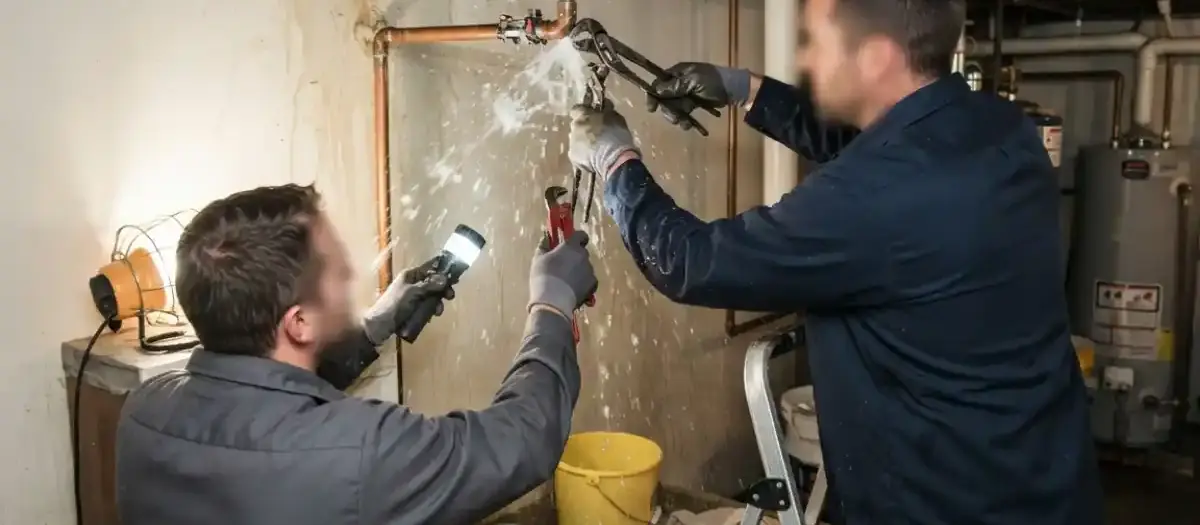
A pipe has burst: the first ten minutes
Stop the water, then call
The fastest way to limit damage is to close the main valve. It is usually near the water meter or where the line enters the house.
- Close the main water shutoff valve completely.
- Open the lowest faucet in the house to drain remaining water.
- Switch off the breaker for any wet area if you can reach it safely.
- Turn off the water heater to avoid dry-firing the tank.
- Photograph the damage, then call the 24/7 line with your address.
If you cannot find or close the main valve, tell us. We guide you by phone and the utility can shut off water at the meter in a pinch.
What causes pipes to burst
Freezing is the best-known cause, but it is not the only one. Corrosion, high pressure, a failed fitting, a nail through a line and shifting soil can all split a pipe. In Upstate South Carolina, freezes are occasional rather than constant, so a hard freeze can catch homes with exposed pipes unprepared.
Pipes in unheated crawlspaces, garages and attics freeze first. When a freeze breaks a pipe, the leak often begins when the ice thaws and water starts flowing.
Water flooding the house?
Close the main and call the 24/7 line now.
Where pipes burst and how we respond
The location shapes the repair.
| Location | Typical cause | Repair approach |
|---|---|---|
| Crawlspace | Freezing or corrosion | Cut out the damaged section and replace with new pipe |
| Wall or ceiling | Freezing, nail or fitting failure | Open a small access, repair and patch |
| Garage or attic | Freezing | Replace the section and insulate |
| Yard or buried line | Soil movement or age | Locate, dig and repair, see water line repair |
Frozen pipes that have not burst yet
If a faucet gives only a trickle in freezing weather, a pipe may be frozen. Open the faucet, warm the pipe slowly with a hair dryer, and never use an open flame. If you see a bulge or a crack, shut off the water and call us.
Prevention is simple. Insulate exposed lines, disconnect garden hoses, and in a hard freeze let a faucet drip. Ask us about insulating crawlspace and garage lines.
What a burst pipe repair includes
After the water is off, the work follows a set order.
- Finding the break and confirming it is the only one.
- Cutting out the damaged section and installing new pipe and fittings.
- Pressure testing the line before closing walls.
- Checking nearby pipe for similar weak spots.
- Explaining what to do about wet drywall, insulation and flooring.
Water damage and what to do next
Plumbing repair is only part of the response. Wet drywall, insulation and flooring need drying, and mold can start within a couple of days. We stop the water and fix the pipe, and we can tell you what we saw to help with an insurance claim.
For leaks that are not yet bursts, see leak detection to find the source early.
Prepare your house before a freeze
Prevention is much cheaper than repair.
- Insulate exposed pipes in crawlspaces, garages and exterior walls.
- Disconnect garden hoses and cover outdoor faucets.
- Open cabinet doors under sinks on exterior walls during a hard freeze.
- Let a faucet drip on the coldest nights.
- Know where your main shutoff is and test that it turns.
After the repair: drying and next steps
Once the pipe is fixed, the wet materials need attention. Wet drywall and insulation should dry within a day or two with air movement, or be removed. Standing water under flooring needs to be dried, since mold can start within a couple of days.
Plumbing repair and water damage restoration are different trades. We repair the pipe and give you a written account of what we found. A restoration company handles drying, and your insurer decides what is covered. Keep photos and receipts from the start.
Guidance behind the first-ten-minutes steps
The steps on this page match the U.S. Environmental Protection Agency's advice on water damage, which says to stop the source and dry wet materials within 24 to 48 hours. Repairs follow the IPC as adopted in South Carolina.
What shapes the cost of a burst pipe repair
We quote the repair in writing before we begin.
Burst pipe questions
Yes. Burst pipes are our top-priority call. The 24/7 line dispatches a plumber and we guide you through shutting off the water.
It is usually near the water meter, in the basement, crawlspace or utility room, or where the line enters the house. Find it before an emergency and test that it turns.
Yes, if water is draining from the system. Switch off the breaker or gas control so the tank does not run dry.
Insulate exposed lines, seal drafts in crawlspaces, disconnect hoses and let a faucet drip in a hard freeze.
Often for the resulting damage, not for the pipe itself. Photograph everything, keep receipts and call your insurer.
If the break is in a long run of old pipe, ask about repiping. We cover Easley, Pickens and Central.