
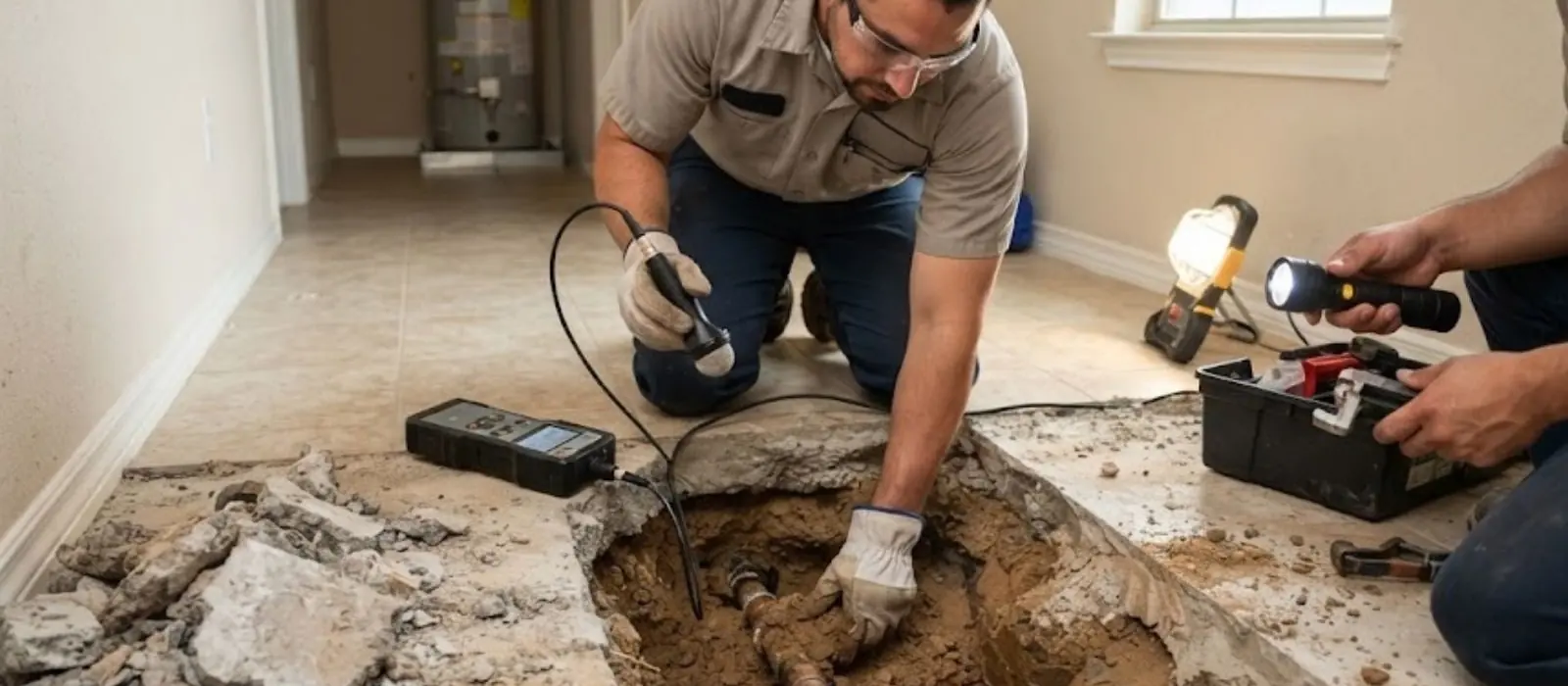
What a slab leak is
Some houses have water lines that run through or beneath the concrete foundation. Over time, a line can corrode, rub against rock or shift with the soil, and begin to leak. The water may soak the slab, the soil beneath or the flooring above.
Not every Easley home sits on a slab. Many have crawlspaces, so the first step is confirming the foundation type and tracing where the lines run.
Signs of a slab leak
These signs warrant a closer look.
- A warm or hot spot on the floor, often from a hot line leak.
- The sound of running water when nothing is on.
- A water meter that moves with every fixture off.
- A sudden rise in the water bill.
- Cracks in walls or tile, or damp carpet at a floor edge.
- Low water pressure or reduced hot water.
Hot spot on the floor?
Call the 24/7 line and shut off the main water in the meantime.
Repair options for a slab leak
The right option depends on the pipe, the location and how many leaks there are.
| Option | When it fits | Trade-off |
|---|---|---|
| Spot repair through the slab | A single, well-located leak | Breaks concrete and floor finish |
| Reroute lines overhead or through walls | Repeated leaks or multiple failing runs | Opens walls or ceilings, avoids the slab |
| Repipe the affected zone | Aging pipe with a history of leaks | Larger project, longer-lasting |
| Epoxy lining | Select cases with sound pipe | Not always available, depends on pipe condition |
When a slab leak is an emergency
Reduce damage right away
A slab leak can undermine flooring and the foundation soil. Hot water leaks also run up your energy bill.
- Close the main water valve.
- Turn off the water heater to protect it, since the tank may drain.
- Keep people off wet flooring if it is slippery.
- Move furniture and rugs from the affected area.
- Call the 24/7 line and tell us if you notice a warm spot.
If you have a crawlspace, tell us. The leak may be accessible without breaking any concrete.
Finding the leak before cutting concrete
We combine a pressure test with acoustic listening to narrow the zone, then confirm the spot with a locator and, where possible, thermal imaging. The goal is to open the smallest area possible.
Our general leak detection page explains the methods in more detail. Slab work adds the choice between breaking concrete and rerouting.
Repair or reroute: a decision about the whole system
A single clean leak in good pipe may be a one-time repair. A second slab leak a year later is a different story, because the same corrosion that caused the first one is usually present elsewhere.
If the house has multiple failing runs, ask us about rerouting or repiping. It costs more upfront and can prevent repeated demolition.
What to expect on the day of a slab leak repair
The sequence keeps the disruption small.
- The plumber confirms the leak location with listening gear and marks it.
- The area is protected with floor covering and dust control.
- The slab is opened in a small square or the reroute is begun.
- The pipe is repaired or replaced and pressure tested.
- The opening is patched, and the floor finish is handled by the right trade.
Foundation and soil questions
Water that has been leaking under a slab can soften the soil. A small, short-lived leak rarely causes damage. A long-running one can lead to settling, cracks in walls or doors that stick. If you see those signs, mention them on the call.
We are plumbers, not structural engineers. If we see signs of settling, we tell you honestly and suggest having a structural professional look. We do not guess about the foundation.
Sources for slab leak and foundation decisions
Plumbing repairs follow the IPC as adopted in South Carolina. Structural questions, such as settling or cracks, belong to a licensed structural engineer, and we tell you when a finding on a slab job should go to one.
What shapes slab leak pricing
We quote the work in writing before we start.
Slab leak questions
Yes. Our 24/7 line dispatches a plumber for suspected slab leaks at any hour.
Check whether you can crawl or walk under the floor. If the floor sits directly on concrete with no access underneath, it is likely a slab. A plumber can confirm.
A long-running leak can soften soil beneath a slab and cause settling. That is one reason to act quickly.
Sometimes by rerouting the line overhead or through walls. It depends on the layout.
We check those first with a meter test and by isolating zones. If they are clear, we narrow the search to the slab.
For leaks in other areas, see burst pipe repair or water line repair. We serve Easley and Powdersville on the same line.