
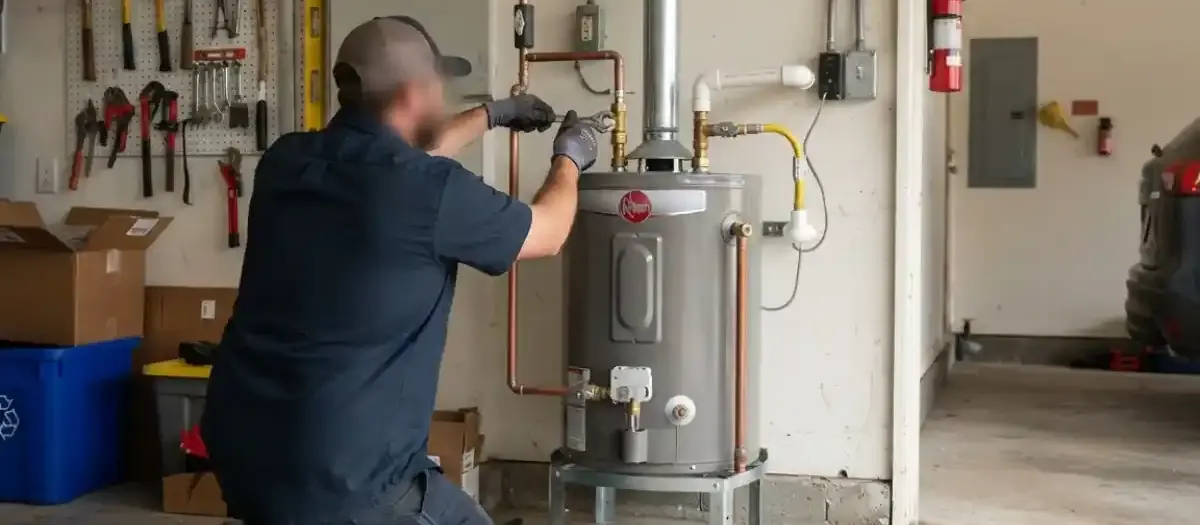
Where the install starts
Every installation begins with three questions. Where will the heater sit, what fuel will it use, and how much hot water does the house actually use at the same time. The answers decide the unit, the venting and the supply lines.
If you are replacing a failed heater, our replacement page covers the emergency side. This page is about planning.
What we check before we quote
A good quote comes from a site check, not a guess.
- Clearance around the unit and any door or attic hatch it must pass through.
- Gas line size, electrical capacity and breaker rating.
- Existing flue or vent path, and whether it meets current requirements.
- Floor drain or pan location for a safe discharge route.
- Water pressure at the house, since high pressure shortens heater life and may call for an expansion tank.
Planning a new water heater?
Call and we will walk through the options and quote before any work starts.
Install options by fuel and layout
The right setup depends on what the house already has.
| Setup | Good fit | Watch for |
|---|---|---|
| Gas tank, existing flue | Replacing a like-for-like unit in a garage or closet | Flue condition and combustion air |
| Electric tank | Homes without gas or with limited gas supply | Panel capacity and wire size |
| Tankless, gas | Households wanting continuous hot water | Larger gas line and condensate or vent changes, see tankless water heater |
| Relocation | Moving a heater to a garage or utility room | New supply lines, drain and venting runs |
Installing in an older Easley home
Homes built in Easley's mill and railroad era often have tight closets and older water lines. We check the shutoff valves and supply pipes before cutting in, because a stuck valve found at the last minute turns a short job into a long one.
Where lines are badly corroded, we explain whether a local fix will hold or whether it is time to look at repiping.
Local water and what it means for your heater
Easley Combined Utilities treats surface water from Saluda Lake. Its 2023 report lists an average hardness of 6 mg/L and a pH of about 7.2, with polyphosphate added for corrosion control. Those figures describe soft, near-neutral water.
That helps your new heater because heavy scale is less of a concern than in hard-water areas. We still install a drain valve you can reach for flushing, and a shutoff on the cold line so future service is easy.
Permits and licensed work
South Carolina's Residential Builders Commission licenses residential plumbers for work above 500 dollars. Ask any plumber for their license and check it with the state lookup tool.
Permit rules vary, so ask the City of Easley building department about your address. If a permit is needed, we handle the paperwork with you and arrange the inspection.
Installation checklist before we start
A short list of site items speeds up a planned install.
- Clear access to the install location and a path from the door.
- The make and model of the old unit, or a photo of its label.
- The fuel you want: gas, electric or a heat pump unit.
- Notes on any past leaks, venting issues or inspection comments.
- A preferred schedule, since planned work can be booked ahead.
Placement and clearances
The location of a water heater matters as much as the unit. It needs room for service, a drain pan where a leak could damage finished space, and clearances from walls and combustibles that the manufacturer sets. A heater in a closet needs combustion air, and a heater in an attic needs a safe way down for service and a drain to the outside.
If you are moving the heater, tell us early. A new location changes the venting, the gas or electrical run and the water lines, and each adds to the quote.
Where the install requirements come from
South Carolina adopts the International Plumbing Code (IPC) and the International Residential Code (IRC) through its Building Codes Council, with state modifications. The edition in force is listed on the council's page at the state Department of Labor, Licensing and Regulation. The manufacturer's instructions add their own clearances and venting rules, and an install has to meet both.
What shapes an installation quote
You will see the price in writing before work starts.
Water heater installation questions
Count the people and the fixtures that run at the same time. Two people often do well with 40 gallons, while four or more usually need 50 gallons or a tankless unit.
Yes. Relocation needs new supply lines, a drain or pan, and a venting plan. We price those pieces separately so you can see where the cost comes from.
Not always. Tankless units cost more upfront and may need gas or electrical upgrades, so the savings depend on how much hot water you use.
We handle rough-in and final set for builders and owners. Our plumbing installation page covers the rest of the new-build scope.
It protects you from unpermitted work, incorrect venting and relief line mistakes. You can verify any South Carolina residential plumbing license through the state's online lookup.
We install in Easley and in Pickens and Central. If your current heater is leaking now, see water heater repair.