
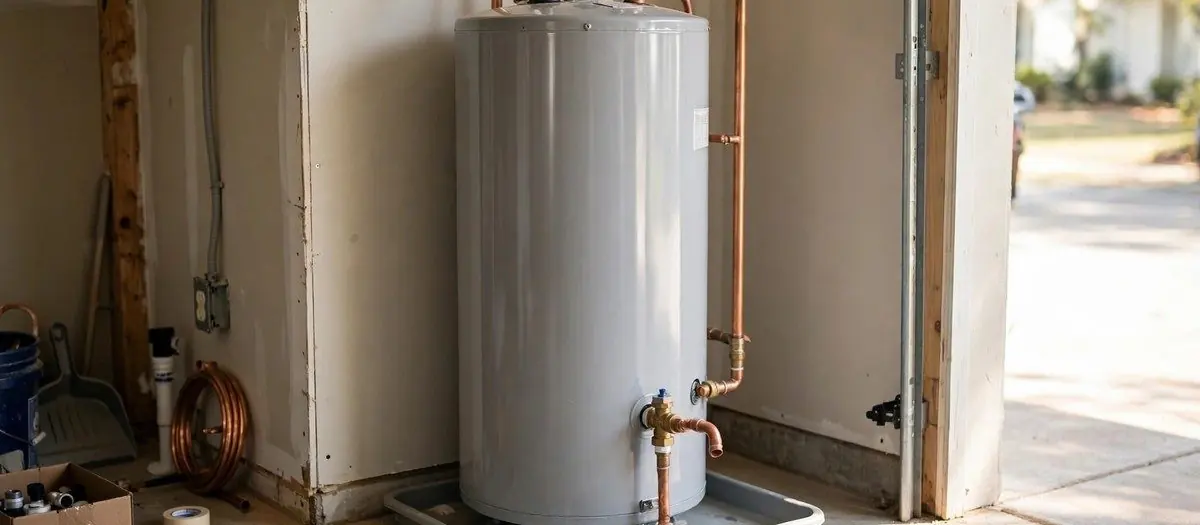
Choosing the right tank
Tank size is set by household use, not square footage alone. A rough guide is 40 gallons for one to two people, 50 gallons for three to four, and larger for a bigger family or a soaker tub. The first-hour rating on the label tells you how much hot water the tank can deliver in an hour.
Fuel is the other choice. Gas heats faster and costs less to run in many homes. Electric needs no vent and is simpler to install. A heat pump unit uses less power but needs space and airflow.
Steps in a standard installation
A plumber follows a set order.
- Shut off the water and fuel or power, then drain the old tank.
- Disconnect and remove the old unit.
- Set the new unit on a drain pan, level and plumbed to a safe drain.
- Connect water lines with new flex connectors or copper, and install a shutoff.
- Connect gas and venting, or the electrical supply, following the manual.
- Install a temperature and pressure relief valve and discharge pipe.
- Fill the tank, purge air, light or power it and test.
Add-ons that code or conditions can require
Not every job needs all of these.
| Item | Why it is used | When it is needed |
|---|---|---|
| Expansion tank | Absorbs pressure when water heats | Closed systems with a backflow device or pressure regulator |
| Drain pan | Catches a leak and guides it to a drain | Tanks in finished spaces or above living areas |
| Seismic or strap kits | Secures the tank | Where local code requires |
| New venting | Safe exhaust for gas units | When the old flue does not meet the new unit |
What can go wrong with a DIY install
Gas and electrical connections, venting and the relief valve are safety items. A mistake can cause a gas leak, carbon monoxide or a scald. Many insurers also expect a licensed plumber for a gas appliance. We do the work to the manufacturer's instructions and the code.
If your current tank is leaking and you want to know whether to repair or replace, see water heater repair and water heater replacement.
Planning the day of installation
Clear a path to the heater and tell us where the water and gas shutoffs are. You will be without hot water for a few hours, so plan showers around it. We haul away the old tank, and we explain how to flush the new one once a year.
If you are also changing fuel or moving the heater, tell us before the quote. That is where the scope changes. Our water heater installation page has more on planned work.
Safety items that should never be skipped
The temperature and pressure relief valve is the safety device that opens if the tank gets too hot or the pressure climbs too high. It needs a discharge pipe that runs to a safe spot, and that pipe must not be capped or reduced. A tank without a working relief valve is a hazard.
A gas unit also needs a proper flue and enough combustion air. If the vent has the wrong slope or leaks exhaust, carbon monoxide can enter the house. We check the draft after the burner lights, and we recommend a carbon monoxide alarm near any gas appliance.
Finally, set the thermostat. A setting around 120 degrees reduces scald risk and saves energy. If someone in the house is very young or elderly, keep it there.
What to do the day after installation
A short check protects the new tank.
- Look at every connection for a drip or a damp spot.
- Check the drain pan and the relief valve pipe for any water.
- Confirm the temperature is set where you want it.
- Run hot water at each fixture to clear air from the lines.
- Write the install date on the tank and keep the manual with your records.
Standards for a tank installation
Gas storage heaters are built to ANSI Z21.10.1, relief valves to ANSI Z21.22 and installation follows the IPC as adopted in South Carolina. The U.S. Department of Energy suggests a thermostat setting of 120 degrees for most homes.
What shapes the installed price
We quote in writing before the old tank comes out.
What this means in Easley, SC
The water in Easley comes from Saluda Lake through Easley Combined Utilities, and its 2023 report lists average hardness at 6 mg/L. Soft water means less scale in the bottom of a tank than in hard-water areas, so Easley tanks often last as long as the manufacturer's rating suggests, and an annual flush is usually enough.
Ask the City of Easley building department whether your address requires a permit for a water heater swap. If your home is in the county, ask the county office. South Carolina requires a license for residential plumbing work above 500 dollars, so verify anyone you hire.
Tank water heater questions from Easley homeowners
Most tanks last about 8 to 12 years. Soft water and an annual flush help a tank reach the upper end of that range.
Yes, if a gas line and a vent are available. The extra work raises the price.
It depends on your address. Ask the City of Easley building department, or the county office if you live outside the city.
Match it to the most hot water your household uses in an hour. We can size it on a visit.
Yes. We haul it away as part of the job.
For homes toward the county line, see Powdersville. A leaking tank in the middle of the night is covered by our 24/7 water heater repair line.