Why a tankless unit needs flushing
A heat exchanger works by moving heat from a flame or element into water passing through narrow channels. Minerals in the water can leave a thin layer inside those channels. Scale acts as insulation and as a restriction, so flow drops and the unit works harder.
Flushing circulates an acidic solution through the exchanger to loosen that scale, then rinses it away. Done regularly, it can keep the unit running at its rated flow.
Common cleaning solutions
Check your owner's manual first, since the manufacturer may specify a solution.
| Solution | How it works | Notes |
|---|---|---|
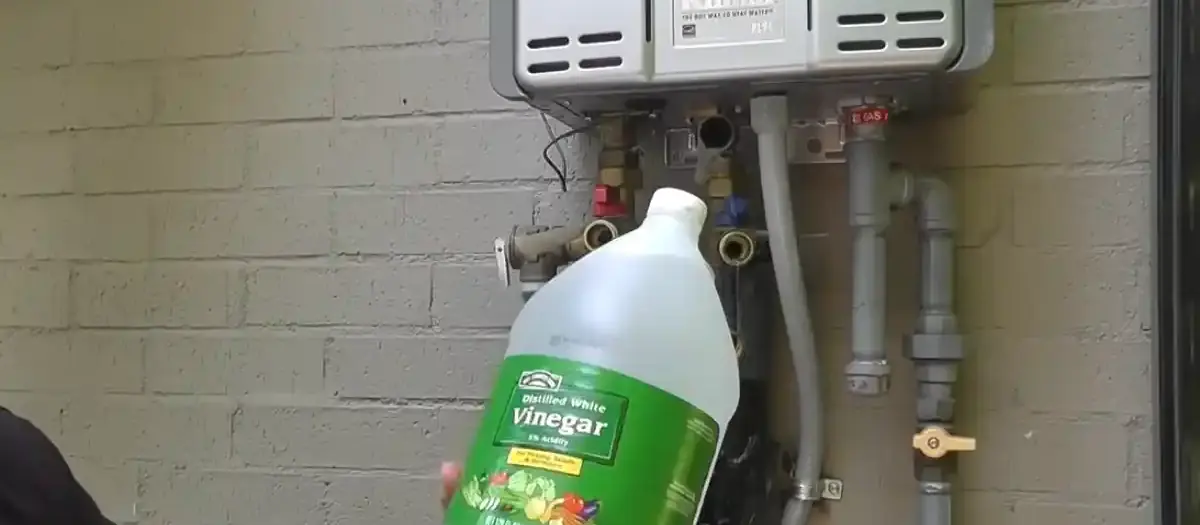
| White vinegar | Mild acid dissolves light scale | Common, cheap and the usual choice |
| Manufacturer descaler | Formulated for the exchanger materials | Follow label dilution and contact time |
| Citric acid solution | Milder acid used in some descalers | Rinse thoroughly |
| Strong acids | Aggressive and can damage parts | Avoid unless the manufacturer approves |
How a flush works
You need a small pump, two hoses and a bucket. Service valves make it much easier.
- Turn off power and gas to the unit.
- Close the cold and hot isolation valves and open the service ports.
- Connect hoses from the pump to the cold side and from the hot side to the bucket.
- Pour the solution into the bucket and circulate it for the time the manual gives.
- Drain the solution, then flush with clean water to rinse.
- Close the service ports, reopen the valves, restore power and gas and check for leaks.
Do not skip the rinse
Any acid left in the line can irritate skin and corrode fittings. Rinse until the water runs clear and has no smell. Also clean the inlet screen, which catches debris and is easy to forget.
If the unit shows an error code after a flush, check for air in the lines and a closed valve before you assume damage. Our tankless water heater page lists common causes.
How often to flush
Hard water may call for a flush every six months. Soft water can stretch that to a year. If you notice lower flow, longer waits for hot water or error codes, flush sooner. A professional service call can also check the burner, vent and gas pressure at the same time.
If a flush does not restore performance, the heat exchanger may have damage or the unit may be at end of life. At that point see water heater replacement.
Signs your tankless unit needs a flush sooner
Do not wait for the calendar if the unit tells you something is wrong. A drop in flow at the shower, water that takes longer to turn hot, a unit that cycles on and off or an error code that points to the heat exchanger are all reasons to flush early.
Also listen. A rumbling or kettle-like sound from the unit can mean scale on the exchanger surface. A flush often clears it, but if the sound returns quickly, have the unit checked for a failing part rather than flushing again and again.
Keep a log with the date, the solution and how long you ran it. If you ever need warranty service, a record shows that you maintained the unit as the manufacturer asked.
Mistakes that damage a unit during a flush
Most flush problems come from rushing.
- Skipping the power or gas shutoff before opening the service ports.
- Using a strong acid that the manufacturer does not approve.
- Running the pump dry because the bucket was too low.
- Forgetting to reopen the isolation valves, which starves the unit of water.
- Leaving air in the lines, which triggers an error code at first use.
Where flush instructions come from
The manufacturer's manual sets the guidelines for which cleaning solution and contact time to use. Manufacturers and the U.S. Department of Energy both describe periodic flushing as routine tankless maintenance, and Easley's soft water relaxes that schedule.
What shapes the cost of a flush service
A flush is a small job, but the visit can find other issues.
What this means in Easley, SC
Easley Combined Utilities lists average hardness of 6 mg/L in its 2023 report, with Saluda Lake as the source. That is low, so scale builds slowly in Easley homes. Many owners can flush once a year and still keep good flow. The utility also adds polyphosphate for corrosion control, which is one more reason the water here is gentle on a heat exchanger.
If you live in Powdersville, Liberty or Central, your water comes from a different system and the numbers differ. Ask your utility for its latest water quality report before you set a flush schedule.
Tankless cleaning questions from Easley homeowners
It is the common choice and many manufacturers allow it. Check your manual, because some units specify a different solution or contact time.
Easley water is soft, so many units do fine with a yearly flush. Flush sooner if you see lower flow or an error code.
It is much harder. A plumber can add service valves, and they make every future flush easy.
Air in the lines or a closed valve is the usual cause. Check those first, then call us if it persists.
Not if you follow the manufacturer's instructions. Some warranties actually require regular maintenance, so keep a record.
If your unit is not heating well after a flush, see water heater repair. We serve Easley, Liberty and Pickens.